How do solar panels work? They turn sunlight into electrical energy through a process called the photovoltaic effect. Inside each panel, layers of semiconductor material—usually silicon—respond when light reaches them. Photons transfer energy to electrons, helping them move through the cell. That movement creates direct current, or DC.
A single cell produces only a small amount of power. Connected cells form a module, and modules combine into an array. Wires carry the DC electricity to an inverter, which converts it into alternating current, or AC, for many household appliances. The meter, inverter display, and cables may look ordinary. The physics is not.
International Energy Agency executive director Fatih Birol called solar “the new king of electricity markets.” His remark describes solar’s growing role in energy supply, rather than the cell-level process. Panels can still generate electricity on cloudy days, though less than under bright, direct sun. Heat, shade, panel angle, and wiring also affect output. Small losses matter.
This is a useful outline, not the whole story. Real installations include protective equipment, monitoring, and often batteries or grid connections. A panel does not simply “store sunlight”; storage requires a battery or another system. Even a well-designed setup cannot control the weather. Understanding the basic conversion makes it easier to ask better questions about performance, costs, and what a particular roof can actually deliver.
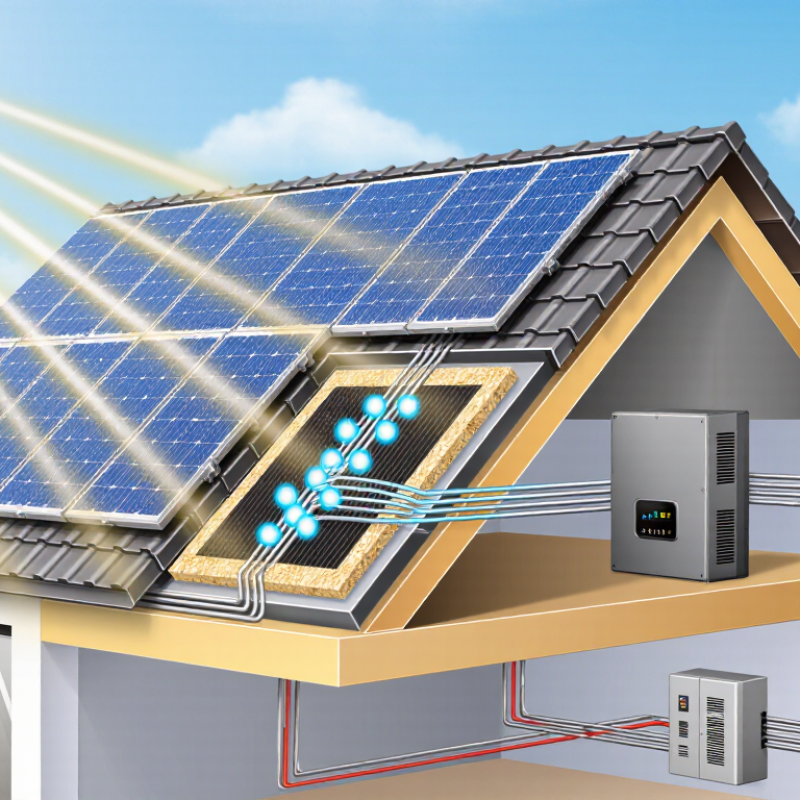
A solar panel is a sealed assembly of photovoltaic cells, not a single sheet that simply “makes” electricity. Sunlight energizes electrons in a semiconductor, usually silicon. The cell’s internal electric field helps direct their movement, producing direct current. Small, but important. Fraunhofer ISE’s Photovoltaics Report 2024 estimates that crystalline-silicon cells account for about 98% of the global market.
Most panels protect their cells between tempered glass and polymer layers. Behind them sits either a protective backsheet or another sheet of glass. An aluminum frame guards the edges, while copper ribbons and a junction box carry current outward. IEA PVPS Task 12’s 2020 report estimates that glass makes up roughly 70% of a typical crystalline-silicon module’s mass. The exact share varies by design. Polymers help seal out moisture, but they can make material separation harder during recycling. A panel’s layered construction is practical, though not perfectly simple. Even a damaged seal can let moisture threaten parts that still look intact.
| Component or Stage | What It Is | How It Works | Key Facts |
|---|---|---|---|
| Solar cells | Semiconductor devices, most commonly made from crystalline silicon. | Light absorbed by the semiconductor gives some electrons enough energy to move, creating electrical charge carriers. | A typical crystalline-silicon cell produces direct-current electricity when illuminated. |
| Cell junction | An internal boundary between differently treated semiconductor regions in a photovoltaic cell. | The junction’s built-in electric field helps separate electrons and positive charge carriers, encouraging current to flow through an external circuit. | Connecting cells in a circuit allows their electrical output to be combined. |
| Front glass | A transparent protective layer covering the front of most framed modules. | Lets sunlight reach the cells while helping protect them from weather and physical impact. | Solar glass is designed to transmit light while providing a durable outer surface. |
| Encapsulant | A clear polymer layer, commonly made from materials such as EVA or POE, surrounding the cells. | Holds the cells in place and helps protect them from moisture, vibration, and other environmental stresses. | It is positioned between the cells and the front and rear protective layers. |
| Rear layer | A protective backsheet or a second sheet of glass, depending on the module design. | Seals and protects the rear of the cell assembly; a glass rear layer is used in glass-glass module designs. | The chosen construction affects the module’s protection and physical design. |
| Frame | A rigid perimeter frame, commonly made from aluminum, on many modules. | Supports the module edges and provides a mounting interface for suitable racking systems. | Some modules are designed without a conventional frame. |
| Conductors and busbars | Metal contacts and ribbons that connect cells within the module. | Collect electrical current from the cells and carry it toward the module’s output leads. | Cells are electrically connected in series, parallel, or a combination, according to the module design. |
| Junction box and bypass diodes | An enclosure on the rear of many modules that connects to the output cables and may contain bypass diodes. | Bypass diodes provide an alternate path for current around cell sections when those sections are shaded or otherwise restricted. | Diodes can help limit hot spots and reduce the effect of partial shading on a module’s output. |
| Photovoltaic effect | The process that converts light into electrical energy in a solar cell. | Photons transfer energy to charge carriers in the semiconductor; the cell’s electric field helps drive their movement as current. | The module produces direct current (DC), not alternating current (AC). |
| System conversion | An inverter or other power-conversion equipment connected to the solar array. | Converts the array’s DC electricity into AC electricity for compatible building circuits or grid connection. | Conversion equipment is part of the solar power system, not usually a component inside the solar module. |
It is a sealed assembly of photovoltaic cells, not one flat sheet. Most cells use silicon.
Sunlight energizes electrons in the cells. An internal electric field guides their movement, producing direct current. Small, but important.
Tempered glass and polymer layers protect the cells. A backsheet or second glass layer covers the rear, while an aluminum frame guards the edges.
Copper ribbons carry current to a junction box. The box connects the panel to the rest of the system.
Shade, panel direction, roof angle, and sunlight intensity all matter. Even a chimney’s shadow can affect production. Dust and pollen can also dim the surface.
No. Solar cells generally become less efficient as they heat up, so a cool, clear day may outperform a hotter one.
One common modeling estimate assumes about 14% in system losses, including wiring and inverter effects. Actual losses vary by installation.
Studies report a median decline near 0.5% per year, but individual systems differ. That figure is not a promise for every roof.
Not perfectly simple. Glass makes up roughly 70% of a typical panel’s mass, while sealing polymers can make material separation harder.
How do solar panels work? They use solar cells, usually made from semiconductor materials, to capture energy from sunlight. When light reaches the cells, it energizes tiny particles and creates an electrical flow. The cells produce direct current (DC), which moves through the panel’s wiring and can be collected for use or conversion.
Because many household appliances use alternating current (AC), an inverter changes the panel’s DC electricity into AC. The amount of electricity a panel produces depends on factors such as sunlight intensity, shade, panel angle, temperature, and the system’s condition. Strong, unobstructed sunlight generally allows the cells to generate more power, while cloudy skies or shading can reduce their output. Together, the solar cells, wiring, and inverter turn sunlight into electricity that can help power a home or other building.

 Halkirk Solar